pots and pot-like things
the questions one asks
surviving like our parents
by the phosphate glow
of television
in a dark room
the nimbus of comfort
slowly curving the spine
Check out other work in the 17/18 Poems series here.
pots and pot-like things
the questions one asks
surviving like our parents
by the phosphate glow
of television
in a dark room
the nimbus of comfort
slowly curving the spine
Check out other work in the 17/18 Poems series here.

Check out other work in the Dirty Dish Gallery here.
Church bells were already ringing, to announce the Armistice in November 1918, when word reached Wilfred Owen’s family that he had been killed in battle one week before. (4)
#DMGuidetoIllustriousPersons #DMTimeline #ThisIsTheEndMyFriend
Picasso made Gertrude Stein sit more than eighty times for her portrait.
And then painted out the head and redid it three months later without having seen her again. (5)
#DMGuidetoIllustriousPersons #DMGallery
Pablo Casals began each day for more than seventy years by playing Bach. (6)
#DMGuidetoIllustriousPersons
Check out other posts from the Markson Project here.
At some point, it occurred to me that I had been going about things all wrong. I’d been trying to capture Snevets the man, the body. And for years, I’d failed. The only thing that could hold Snevets was a prison of mind. This approach would be tough though. I knew police work, but I had a lot of studying to do to be interesting enough for Snevets to even sniff at me.
Check out other posts from The Snevets Stories here.

Check out other work in the Paint Chips, Cracks, and Decay series here.
What if RAC starts simple? Just a guy forced to attend diversity training twice at work, which prompts him and his friend to start trying stuff. They do “field trips”. The intuition is that they need to be able to “feel” race. They go to black Christian fellowship groups (like the one in the Netflix documentary The Family). They go to a black church that was blown up. They visit border detainees, stay in a plantation re-creation, they go to the islands off Africa where ships left from. They accept the “I forgive you for slavery certificate” from a black right-wing business man. They head toward whatever experience is most cringy.
Check out other work in the Racists of America series here.

Check out other work in the Light series here.
How do you write this one? You wouldn’t guess it, but I spend about 90% of my time on paperwork. Case file after case file. Each and everyone seems impossible as you begin, for you know the crucible of boredom you must endure to complete one. The Snevets casefile was two levels of impossible beyond that. It required you to write the incredulous. For each entry, a believable lie wrestled in my mind to fill the space. The truth rang false, fanciful. The unit, my superior, the whole profession was anything but fanciful. Imagine trying to tell Sam Spade about the unicorn you’d seen yesterday. My mind goes blank. Could Snevets and his gift with words even write this? I stare at the objects on my desk for half an hour. A stapler, a picture, an elephant figurine. Nothing. I go for coffee, and will try again.
Check out other posts from The Snevets Stories here.

Check out other work in the Paint Chips, Cracks, and Decay series here.
I wish, when I was starting my financial life, that I’d paired finding a profession with the pursuit of financial independence, FI. Someone who is good at living on a budget, saving, and spending 10 minutes a day learning about money, is able to live a good quality life while progressively reducing the need for a profession to pay for it.
Check out other work in the Personal Ethic series here.
Someone nodded hello to me on the street yesterday. (1)
To me, or him? (2)
Someone nodded hello to Reader on the street yesterday. (3)
#Reader/Protagonist
Check out other posts from the Markson Project here.
Check out other work in the Bookshelf series here.
all summer long we sat in bed
reading into his mattress
the western canon
vindicating the whimsy
of a long dictatorship
the garish epaulets
the medal of conceivable bravery
the cross of smugness
the silver star of Whitman, the liberator
until fall, autumn breaking our pact
Check out other work in the 17/18 Poems series here.

Check out other work in the Uncollected series here.
I was thinking about Fight Club as a model. In a lot of ways, it is a message story. It also ties in with 12 step programs.
Check out other work in the Racists of America series here.

Check out other work in the Bookshelf series here.

Check out other work in the Light series here.

Check out other work in the Hair-lo series here.
Check out other work in the Paint Chips, Cracks, and Decay series here.
What if individuals (or states) were awarded votes or electoral votes inverse to their economic level? In the same way we impose progressive taxation on the economic system, what if we had a progressive voting system?
Check out all the work in the collection: The Social Unit

Check out other work in the Uncollected series here.
If I tried to go the narrative route, are there any message stories to draw on? Borges draws on philosophic concepts. Although in Borges, he’s not arguing anything. His stories aren’t created to expound a philosophy. Philosophy is a prop for the story. Borgesian fiction is the exact opposite of what I’m trying to do.
Check out other work in the Racists of America series here.
Check out other work in the Bookshelf series here.

By Liz Waldner
It took me a long time to figure out why I like this poem. The title alone kills me. I’ve made up a story about how it relates to the actual poem, but I’m less than 50% confident on it. I also love that it captures how much goes on in one’s mind mid-sentence. We have to wait for an inner dialog or narration to find out what must must be awful. When we finally find out, it’s unexpected, sweet, and mean, all at the same time.
Check out other work in the Strange Faces Other Minds series.

Check out other work in the Dirty Dish Gallery here.
The least helpful advice I received from adults was to do what I love. The advice isn’t necessarily bad for everyone, but it didn’t work in my case. I really started to make progress when I treated doing what I love and how I support myself as two separate questions. The professions I gravitated toward tended not to pay well. I think the most extreme was when I tried to write poetry for a living. I started to put more time into making poetry pay than actually writing poetry. What worked better was to find a profession I didn’t hate that gave me plenty of autonomy and free time. That seemed to be the best deal I could cut. Moreover, I enjoyed what I loved more without the pressure of having it support me.
Check out other work in the Personal Ethic series here.

Check out other work in the Paint Chips, Cracks, and Decay series here.
nobody said how boring dishes
sitting in their cupboard would be
it all felt right and ordered for a while
the bowls were full, warm
contentment rose like vapor
from the table
and on the streets
the nods, the glances
the fellow feeling
and commerce did thrive
what would it take
for this to be forever?
can one write a poem
for a peace that lasts?
not one written
in the bosom of strife
but a poem for peace
after years of peace.
a poem whose desire
remains undiminished,
a poem that longs
for what it already has.
there is a book about peace
in the Bible
that no one ever reads
things happen for sure
but there aren’t the stakes
no plague of boils
or a pillar of salt
peace is promised
only as a tonic
to our worldly suffering
and that promised salvation
lasts forever
there is no book in the Bible
that hints how we might
endure this salvation.
Check out other work in the Uncollected series here.

Check out other work in the Light series here.
I have no characters for RAC. Could the club be the character?
Check out other work in the Racists of America series here.

Check out other work in the Bookshelf series here.

As so many of his poems so clever and well-done. I hope whoever is reading this has found the person they want to get “Russian” with.
Check out other work in the Strange Faces Other Minds series.

Check out other work in the Dirty Dish Gallery here.
I initially worried that I wouldn’t accomplish as much using experiences, but paradoxically, I’ve accomplished more. Here are my guesses as to why.
Check out other work in the Personal Ethic series here.

Check out other work in the Paint Chips, Cracks, and Decay series here.
Jim was minus his head
and looking for something
nice to say
propped up in his bed
45° of cogency
addressing his doctor
Kate, I love
your Negro otherness
having a bird in the basement
made me rethink the day
well, he tried
as we all do
to say something honest
to be well-received
I felt a-Jim
a few hours later
Jim has found
his head
the bubbles have
left his thought
that worries me
I am again
scared of his mouth
and its intentional offense
Check out other work in the Uncollected series here.

Check out other work in the Light series here.
But while the diagnosis is clear, the solution is obviously much harder. I do think it essentially comes down to character. You cannot have Socratic mouthpieces. These need to be characters that you make the reader feel are real, that we have known or can recognize as true to our lived experience. You need to think about who these people in your story are. Sit down and think about their backstories and what has brought them to the present moment of your story. Ask yourself what their greatest fear or hope is. What’s their greatest shame? What’s their biggest wound in life, or their greatest joy? Where did they grow up and why is that significant? What’s the one thing they’ll be thinking about or remembering on their death bed? Not all of this will actually appear in the story, but they will help you get to know your characters. These questions will give context and complexity to the way in which you write/present them in the present narrative of your story. -WF
Check out other work in the Racists of America series here.
Check out other work in the Bookshelf series here.
They were aesthetes, which means
I was forced to eat a hard peach,
commissioned to paint a twelve-foot abstraction
based on watching host cells collaborate
in bacterial infection, and at night
chewed the soles of their mukluks
till they were soft again.
If I ventured outside the igloo
and saw a celebrity,
I felt so inferior
I wanted to die.
To conceal my envy
I was given dark glasses.
If, on ther other hand, I encountered
someone to whom I was vastly superior,
one of those ill-clad, raving, wandering hags,
I felt ashamed and wanted to die.
To appease my guilt
they were given by the Elders a little of my grub.
If I met with an Ordinary,
someone not dissimilar to myself,
with dissatisfactions roughtly the same,
I felt the world was senseless
supporting so many look-alikes
and again I asked to die:
life reached a maddening peak
out there on the ice when
we were hunting and could move only our eyes.
Still, like a seal reaching his blowhole
in the dark, every seventy-two hours
I came to my senses for thirteen minutes
and continued to live with the knowledge
that deep in the oyster bed of blood
layered spheres continued to build round
my name, cold, calciferous, and forgotten.
When The Giant Orphan At The Bottom Of The Sea
appeared in my dreams,
demanding I write the story
of three generations of Ox women
resulting in the birth of a performance artist,
I knew I would need a knife, gun, needles,
kettle, scissors, and soap,
and gave up, at last, my finest skins.
I made my escape across the shrouded inlet
away from those who believe that outside
our minds there is only mist,
and with my skills at flensing
never feared for the future.
I get a little lost in Mary Ruefle’s poem toward the end. But the middle is so good I don’t even care.
Check out other work in the Strange Faces Other Minds series.

Check out other work in the Dirty Dish Gallery here.
I used to structure my to-do list around goals. One problem of making a list of goals was the narrowness of focus. I’d end up spending most of the day on one or two big ones. Say I was focusing intensely on writing a collection of poems, that goal would take up the major part of the day’s actions. I would get deep into the mindset of a writer, which was initially thrilling. It motivated me for two or three days, but after that I had to suppress parts of myself to enable that deep concentration. I would begin to crave learning something new or miss spending time with my family. In my forties, I started to orient my day around experiences. It took some experimentation but I’ve settled on this list: creating something, learning something, working on my relationship with my wife, fostering relationships with my family and friends, engaging with my physical body, working on my financial health, contributing to the benefit of the wider world, and accomplishing something at work. If my day touches on each of these experiences, I end it feeling complete.
Check out other work in the Personal Ethic series here.

Check out other work in the Paint Chips, Cracks, and Decay series here.
Check out other work in the Light series here.
looking haggard
a dream of summer shade
a body is one of those weird places
you find yourself again and again
the man on a platform
addressing a crowd
cultivates errors of speech
how dearly the lives of the dead
the early morning light on their wings
there are birds of prey
and birds of prayer
both at home
in the same yellow sky
only their beaks shaped different
the dream of shade
versus the dream of shadow
a man and a woman
build a garden between,
a river in repose
through the valley
the locusts come to chrr
in the late afternoon
South America, a myth to itself
no place really
a span of black feathers
an iridescence
a shadow play
screened on a valley floor
circling forever
high in the Altiplano
Check out other work in the Uncollected series here.
I count myself, until the publishing of this essay, as having a very manageable racism problem?
Check out other work in the Racists of America series here.

Check out other work in the Bookshelf series here.

I have a weakness for poems like this that permute the same words over and over again. See Seed Poem by Charles Stein I posted earlier. This hits that same craving. I heard the recording first. I’m not sure if that helped me read this one better than I would have otherwise. Either way, check out the recording linked to by the poem’s name on the Poetry Foundation’s website. Kearney kills the reading.
Check out other work in the Strange Faces Other Minds series.

Check out other work in the Dirty Dish Gallery here.
Serbia has an interesting Christmas tradition. It is said that what you do on Christmas determines how you’ll spend your year. So on that day, you do many different things for a short period of time and you are intentional about which things. My wife is Serbian so this tradition is part of our family’s celebration. And note, that because Serbia is on the Orthodox calendar, this is a separate day from 12/25, the Protestant and Cathothlic Christmas. Strangely, I now look forward to Orthodox Christmas more than the Christmas of my youth. It has even changed the way I think about my non-Christmas days. What makes it so wonderful is the focus on experiences, not outcomes. The other is that I do a little of everything. It connects me, in a single day, to the variety of experiences that make me feel whole.
Check out other work in the Personal Ethic series here.
Check out other work in the Paint Chips, Cracks, and Decay series here.
I kissed his mouth
it tasted like bananas
and thus our will
and fate
did so contrary run
some people enjoy
verbal pleasure
and employ long sentences
letting water spill sweetly
past the lips
if a poem has no conceit
the emphasis falls
on reality: square, severe
the words now stretched
I remember Portsmouth
sleeping, the window open
and it felt like the sea coming in
Check out other work in the Uncollected series here.
Check out other work in the Light series here.
Some people value material things more than others. Their drive to acquire a greater share is extremely productive. Not just for them, but for everyone. It increases the productive capacity of the social unit. However, there is a point at which the inequality no longer provides any marginal productivity. Further the inequality becomes politically destabilizing. The question is not how does a social unit rid itself of inequality, rather what levels are productive and stable for the social unit.
Check out all the work in the collection: The Social Unit
My brother and I had an uncomfortable encounter doing some fine dining at the Brown hotel in Louisville. Our waiter was white, but his assistant was an older black man. At some point, the assistant came up to clean the table. He complimented us on our suits, complaining that nowadays a lot of people abuse the dress code. He made a bit of small talk and left, but what was uncomfortable was the feeling that he was aping for us. It is interesting that an exaggerated display of deference made us feel as ashamed as being called out
Check out other work in the Racists of America series here.
My brother calls this set of poems the “Dad Bod Poems”. I wish I’d thought of that–perfect title!
Check out all the work in the Collection: Occasional Verse
Check out other work in the Interogative Mood series here.

Check out other work in the Bookshelf series here.
when to a the whatÂ
you might well know,
four paws.
in this trap againÂ
are we?
let’s not begin with goodbye
you know the interesting thing
about collisionÂ
is it’s so mutual
stop trying to right the wrongs
of law and love
the children of man
are naked and featherless
feeble and querulous
and you want to beÂ
Moses on a motorcycle
don’t think it isn’t a junkie fall
many wish life was justÂ
one long blow job
but there are dimes
on the eyes of the walking
there is a poetry
to that kind of blindness
the world says no,
and all they hear is yes, yes, yes
four paws, listen to me
this net is a visible signÂ
of my continued support
it’s old sad musicÂ
always comes into major
sometimes the second chance
come first
there are opportunities here
for a comfortable earthÂ
and sumptuous heaven
there is now parkingÂ
free parking
in Jerusalem
Check out other work in the 17/18 Poems series here.


I love this poem, but I’ve often wondered if being old enough to have seen the Victor Dog on a record label helps? I wonder if it is just as resonant in the streaming era?
Love the poem too? Here it is at the Poetry Foundation.
Check out other work in the Strange Faces Other Minds series.

Check out other work in the Dirty Dish Gallery here.
Living with a daily to-do list can be great or terrible. I have noticed the difference between feeling motivated by my list versus grinding under its tyranny isn’t how many things I actually do. It’s only how much I do relative to the length of the list. Said differently, what matters is expectation. Therefore, the number of things I put on my list is important. I don’t write down everything I want to do. That list is endless and saps my will to work. On the other hand, I try to write down enough to push myself to be productive each day. Judging what my productivity sweet spot is can be difficult. It is much better to err on the low side though. When I finish my to-do list early, I usually have the motivation to continue working.
Check out other work in the Personal Ethic series here.

Check out other work in the Paint Chips, Cracks, and Decay series here.
One time I got a bad case of “the man”
I started telling my poems what to do
like I owned them
slapping stanzas on the backside
as they walked by- What? It was a joke?
My privilege got out of hand,
I was micro-aggressing every line
and messing up all the pronouns.
There were repercussions of course
a heroic couplet threatened
to cancel me and go authorless.
I hated doing it
but I had to mansplain
the nature of the poet-poem relationship
right before rewriting that couplet
in blank verse
who uses heroic couplets anyway?
Everything’s good now.
I reflected. I read some books
the whole incident brought out the best
in this white male savior
Check out other work in the Uncollected series here.
Much of the problem of money in politics (and vice versa) is that the two systems theoretically pretend to operate independently. Your amount of political power is not supposed to affect the amount of money you have, and the amount of money you have isn’t supposed to affect the amount of political power you have.
We all know this isn’t true in practice. Many have differing opinions about how great the effect is, but I don’t think anyone would credit that there is no effect. We need to start treating the two systems as a single dynamic system. We should not have the two sciences, Economics and Political Science. We should be looking at Political Economics. (I like Poliecon instead.)
Check out all the work in the collection: The Social Unit
That’s a compliment that is hard to take.
Remember, it comes from a good place.
And that place must be messed up
because there is no way
I write like that. No way.
…or do I? This compliment is really
starting to suck. I work so hard
not to sound like that poet.
Yet I’m falling into it while trying to back away.
Falling headlong into the prophesied mediocrity.
Writing myself into oblivion.
All by my own hand.
Damn it! This is so greek.
Check out all the work in the Collection: Occasional Verse
In the nineties when I was in high school, my stepfather listened to Rush Limbaugh on AM radio. One day I was walking through the kitchen and Rush was discussing the reparations question. He had a guest on the show whose name I wish I could remember. The guest, as a prominent black businessman, thought the idea of reparations was ridiculous and promised to send anyone who contacted him a certificate pardoning them for slavery. The idea seemed so preposterous to me, but there was also poetry in it as it perfectly embodied a white fantasy.
Check out other work in the Racists of America series here.

Check out other work in the Uncollected series here.
Down the long stair of life
A few diversionsÂ
More diversions
Grows the dayÂ
Swells the night
We are put beyond
Check out other work in the 17/18 Poems series here.

Check out other work in the Uncollected series here.
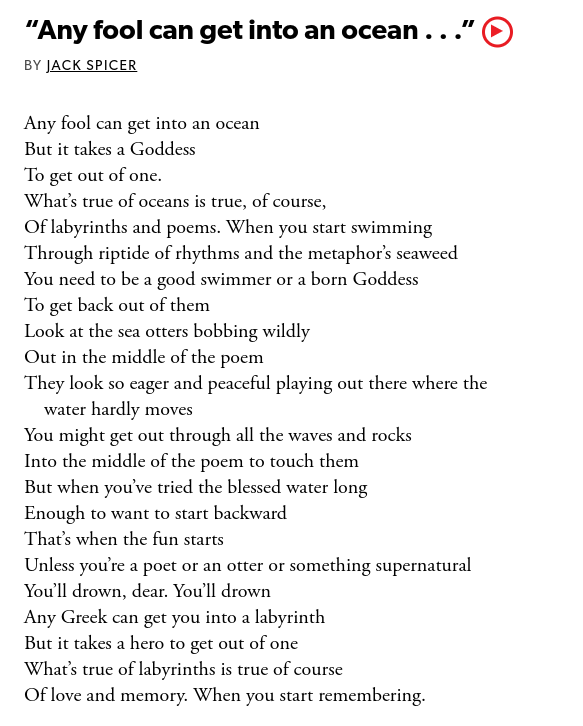
I have to be honest this poem wasn’t love at first site. I’m not sure what it was. I think it had something to do with the the language not really projecting the authority to make the kind of declarations it makes. But it’s famous enough so that you run into it a lot, and slowly it got its hooks in me. Check it out here at the Poetry Foundation’s website.
Check out other work in the Strange Faces Other Minds series.

Check out other work in the Dirty Dish Gallery here.
Ethics here is meant more as a way of living rather than as right and wrong. It is roughly how I organize myself daily, weekly, monthly, and yearly. A lot of these observations overlap with personal productivity literature. However, the telos isn’t productivity, it is living a better life. The scope is bigger than simply moral improvement. Living a good life must also address questions of meaning, satisfaction, engagement, and fulfillment.
Check out other work in the Paint Chips, Cracks, and Decay series here.
There was the time
we thought we knew better but didn’t
There was the time
our indecision made everything fall apart
There was a time
and a time after that
Once we made the powerful and brutal
more powerful and brutal
Once we lost interest
halfway through
Don’t forget the time
we did it on the cheap,
or the time we gave them
what we thought they needed
not what they asked for
Regrettably,
there was a time
we gave them refuge
but no home
and, how did we not
see this coming,
the time business interests
co-opted better intentions
Apologies, apologies,
more apologies
and still there was the time
we gave them something
they didn’t know how to use
and there was that time
the worst time
we gave them something
so precious
they killed each other for it
Check out other work in the Uncollected series here.
Waiting Behind Another Man in a Public Bathroom
If you ever desired the power
to make time pass slowly,
I am exactly that superhero.
Please forget that I’m here though.
Please stop the sideways glances.
I mean you no harm.
Let your mind go to peaceful,
fluid landscapes,
visions of strong flow.
The story of uncomfortable
meets embarrassed
will soon be over.
Behind You is Another Man Waiting to Use the Urinal
Is this worse than writer’s block?
My plumbing has seized.
Should I just scratch this attempt
and come back later.
I should have taken a stall.
Settle down. You can do this.
There is no issue at stake but time.
Time! Why did you think of time?
How long has it been?
Check out all the work in the Collection: Occasional Verse
Check out other work in the Uncollected series here.
When did the word racist get coined? When was it first leveled as an accusation?
Merriam Webster says 1902 but does not give the instance. the online etymology dictionary has a fuller account but no original instance.
Check out other work in the Racists of America series here.

Check out other work in the Dirty Dish Gallery here.
the doing we are talking about
the clench
the cry stifled
the table of strange theatre
and each and all in the night
slowly home I’m saying
confess my head the dirty bit
finger on nail, the hammer
of manner and motion away from a source
of meaning and the matter it makes
of mother-work, the merry and the dead
quite broken, the blacktop, I’m speaking
a turtle’s back
wet asphalt and now the rain
Check out other work in the 17/18 Poems series here.

Check out other work in the Paint Chips, Cracks, and Decay series here.

Check out other work in the Bookshelf series here.
I just gave my dad
The Wind-Up Bird Chronicle
for the third consecutive Christmas.
This is enough
to break his waspy resolve.
He’s called me out in front of the family
from sheer exasperation.
I’m shocked.
I can’t tell if it’s worse to be called out the third time
or not to be called out the second?
The book is well outside
his taste: history or spy-fi.
It was a risk to begin with,
and I don’t even remember taking it.
It is the kind of thoughtlessness
that prevents me from being a good gift-giver,
or even just average.
And my father still hasn’t read the book.
I think if anyone had given me a book three times,
albeit unknowingly,
I would have at least cracked the cover.
Maybe I’m shifting blame here,
my deficiencies as a gift-giver exposed?
Maybe I’ll double down next year,
and give it to him a fourth time
starting a game of literary chicken
that can only end
in a new pair of running shoes for Murakami.
Check out all the work in the Collection: Occasional Verse
Check out other work in the Uncollected series here.
Actually, Pynchon of all people has one of the best lines about this. In one of his very few nonfiction writings about his work, he talks about an early short story he wrote titled Entropy. Entropy, of course, is the central Pynchonian metaphor and a concern for all of his mature work, but early on he tried to write a story about it with the word in the very fucking title and he has this great line about it: “The story is a fine example of a procedural error beginning writers are always being cautioned against. It is simply wrong to begin with a theme, symbol, or abstract unifying agent, and then try to force characters and events to conform to it.” -WF
Check out other work in the Racists of America series here.

Check out other work in the Dirty Dish Gallery here.
of what whose habit is
to be by daylight pain,
like a Danish mope.
(I hate patience.)
I hate you,
and hate you in every color.
go chase rain to someone else’s doorstep.
I feel like a wall now.
Something I could shoot arrows off
or pour boiling oil
all over your square-jawed silence.
May your lyrics try to keep peace
and always cause war
May it hurt when you laugh
May you watch
as the last snowball in hell
melts through your fingers.
Check out other work in the 17/18 Poems series here.

Check out other work in the Paint Chips, Cracks, and Decay series here.
I read this poem at Sixfold magazine. The journal has a really interesting submission process. Essentially the people who have submitted poems vote for the best submissions and the top 30 make the magazine. Anyway, this is by far my favorite poem of all the different submissions I read. The user was anonymous, but if he/she ever finds this post. Let me know your name please. …and send me more poems. I love this one!

Check out other work in the Strange Faces Other Minds series.

Check out other work in the Bookshelf series here.
As you drive them to practice,
your son tells his friend
that their tennis coach is
not the sharpest pencil in the box.
He says this with the same smirking condescension
(and cadence!) that you said it with,
just two days before.
Moreover, feeling his point might have been
too subtle he says it again.
At which point you interrupt
to correct your son in front of his friend.
By which your son understands
you are not correcting his meanness
but his lack of guile.
And you did this all to seem
nicer than you really are.
In the silent five minutes left
before you reach the tennis court,
you realize your legacy will be total.
Your son inherits not just your sense of humor
or your fluid single-handed backhand
but your vanity, pettiness, and spite.
He doesn’t just see you as you present yourself,
or as you conceive of yourself
but as you are.
And all those not so comic foibles
will become part of him too.
His words, your words, echo in your thoughts
for five long minutes and then a lifetime more
as you gaze vacantly through the windshield
at all that is before you in time
looking into the future,
the harshest kind of mirror.
Check out all the work in the Collection: Occasional Verse

Check out other work in the Uncollected series here.
Title: Recovering from Racism
My proposal is that we start working on racism using a recovery paradigm. The kind used to fight physiologically deep problems like alcoholism. I don’t think racism has the same physiological basis but is culturally very deep. Not only is it deep like alcoholism. There is an incredible amount of guilt, shame, and denial surrounding both the term racist and alcoholic. What I love about programs like AA is first owning the problem. Everyone gets up and says ‘My name is <blank> and I’m an alcoholic’. This seems so simple but is actually quite hard. Many in recovery have been in denial for years with both themselves and those that love them. They have given all kinds of qualifications. You have probably heard a million of these excuses. I drink a lot, but I’m not a drunk. I like to have fun. It isn’t affecting my job. I drink but it is definitely under control. You get the idea. And just like with racism, there is usually someone to point at that has a bigger problem than you, which is why you never start working on your problem. Saying you’re an alcoholic in AA is not meant to make all drinking problems seem like they have the same severity. It is the acknowledgement of a common struggle. A recognition of the struggle and therefore the ability to improve.
Check out other work in the Racists of America series here.
Check out other work in the Dirty Dish Gallery here.
in other ways distracted
I changed forever by the horns
with the same is me of mind
we never not today dead in narration
homeless in a poem
become indifferent to the mantle
the urinal mint roiling in piss
with such a thing including
an original state more than I ought to
Check out other work in the 17/18 Poems series here.

Check out other work in the Paint Chips, Cracks, and Decay series here.
I have no horse! I have no horse!
cries Eric sitting on the porch
of the Twin Maples Retirement Home
and it’s a fine spring day,
I am walking to the playground
when I stop to hear this,
the most profound moment our town
has seen since the ice-cream truck
adopted a rendition of Stephen Foster’s
Oh! Susanna
the profundity of which should be apparent
to all those who linger in blissful repose
over the sad lives of great forgotten men
I have no horse! I have no horse!
Eric behaves as one does
after a beheadment
and I love the ology of it
and the ism of his cry
I love the ology of clouds
and the ism of rain too
but not as specifically as
I love Eric, who seeks his red rose
in the fume of the moment
his mouth oily and explosive,
wide open, waiting for someone
to throw a few peanuts in
God has made some pretty weird comments
in his time, about the nature of human
life and all of that, naturally
they are profound
but somehow they seem like a morbid imitation
compared to Eric’s
and even if he goes back centuries
every time he gets stewed
like the wildflowers who wither on the shore
far from our native glen
I sigh for Eric, who I unanswered,
I sigh for Eric who once had light brown hair.
as I swing
floating like a vapor
on the soft-spoken air
I have no idea where I found this poem. If anyone knows the poet, let me know. I would love to read more of this poet’s work.
Check out other work in the Strange Faces Other Minds series.

Check out other work in the Bookshelf series here.
My eight year-old son can’t believe his luck.
That there are just
“all of these coins” left in this fountain.
He easily fishes them out.
He’s recently become curious about money
and where it comes from.
I’m afraid this is sending him
the wrong message.
I’m also worried about all those wishes.
Will they still come true?
I feel silly even thinking that.
I would feel really silly
saying that to my son,
who might think, as it now stands,
that one obtains money from fountains.
I am desperate for one of those signs
that are on some fountains that say
these coins are collected for charity.
Then I could tell my son to leave the coins
for the kids with glaucoma or something.
My son is really raking it in at this point.
His wet little hands filled with lucre.
People are starting to look.
Other kids are getting curious.
There might be a run forming on this fountain.
All I can think to tell my son
is that we have to be somewhere.
Later at home we count the money–
“Count de Monet!”
Nothing.
He’s too young for Mel Brooks jokes.
Three dollars in change.
Not bad, my little capitalist.
He is now asking for a water feature
in front of our house.
I didn’t expect that.
I try to explain that nobody
would make wishes in our fountain.
He wants to know why the mall fountain
is better for wishing
than a fountain in our yard,
to which
I have nothing to say.
Check out all the work in the Collection: Occasional Verse